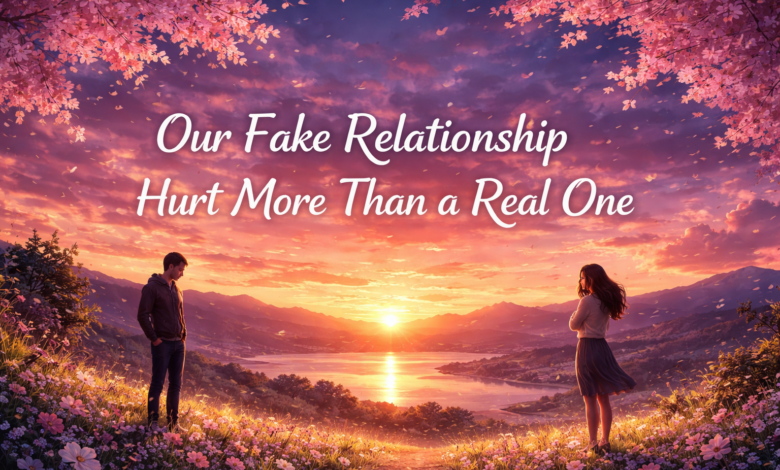
Our Fake Relationship Hurt More Than a Real One
We agreed it would be simple.
No promises. No future. Just a few photos, a few public smiles, and a story convincing enough to keep questions away from both of us. A lie with boundaries. A temporary shelter from the storms we didn’t want to explain.
I believed that. I needed to believe it.
Because if I looked too closely at why I said yes, I would’ve had to face the truth I’d spent years burying.
I met Noah again the night the past decided it was done waiting.
We were standing in the kitchen of my apartment, surrounded by half-empty wine glasses and the soft laughter of friends who believed we were real. Noah’s hand rested on the small of my back—easy, practiced, familiar in a way that made my chest ache. He leaned in to whisper something charming, something rehearsed, and the room blurred.
Not because of him.
Because of the scar on his wrist.
A thin white line, barely visible unless you knew where to look.
I did.
The memory hit me so hard I forgot to breathe.
A hospital hallway. The smell of antiseptic. A younger version of me sitting on the floor, knees to my chest, convincing myself that leaving was the same as surviving.
I pulled away from Noah too fast. He noticed. Of course he did.
“You okay?” he asked softly, still playing his role.
I nodded. Lied. Smiled.
But the past had already slipped back into my life, uninvited and relentless.
Years ago, I loved someone who broke quietly.
Evan didn’t shatter all at once. He cracked in small, almost invisible ways. Missed calls. Forced smiles. Sleepless nights spent staring at the ceiling while I pretended not to notice. I told myself love meant patience. That if I stayed long enough, it would be enough.
Until the night it wasn’t.
He didn’t die. That’s the part people expect, the tragedy they know how to mourn. He survived.
And I left.
I told myself I had no choice. That I was drowning too. That I couldn’t be his anchor if I was sinking.
But the truth—the one I never said out loud—was simpler and crueler.
I was afraid of loving someone who needed me that much.
After that, I became careful. Strategic. I dated without depth, affection without risk. I built a life that looked full from the outside and felt hollow in the quiet.
So when Noah suggested a fake relationship—two lonely people using each other as cover—I agreed because it felt safe.
You can’t abandon someone if it’s not real, right?
The lie worked better than it should have.
We learned each other’s rhythms. Inside jokes. The exact pressure of a hand squeeze that said I’m here without words. We cooked together, argued convincingly, laughed genuinely. Somewhere between pretending and habit, something blurred.
I told myself it was nothing. Just muscle memory. Chemistry. Convenience.
But fake intimacy is still intimacy.
And the worst part?
Noah saw me.
Not the curated version I showed dates. Not the invulnerable woman I pretended to be. He saw the flinches, the walls, the way I always left emotional doors unlocked just enough to escape.
He never pushed.
That’s what hurt the most.
The truth came out on a Tuesday, unremarkable except for the way it changed everything.
We were sitting on my couch, the act finally unnecessary. Our “relationship” had served its purpose. We should have ended it cleanly.
Instead, I asked, “Why did you really agree to this?”
He was quiet for a long time.
Then he said, “Because it’s easier to be chosen for a lie than risk being rejected for the truth.”
My chest tightened.
He rolled up his sleeve, exposing the scar fully now. “I spent years trying to prove I was okay enough to be loved. I thought pretending would hurt less.”
That’s when I understood.
Our fake relationship wasn’t protecting us from pain.
It was preserving it.
I told him about Evan. About the hospital hallway. About leaving without looking back. About the guilt that shaped every careful choice afterward.
“I thought if I kept things unreal,” I said, voice breaking, “I couldn’t fail anyone again.”
Noah didn’t interrupt. He didn’t offer comfort. He just listened.
When I finished, he said, “You didn’t fail him. But you did disappear.”
The words landed hard because they were true.
I had built my entire future around avoiding the risk of being needed—and in doing so, I’d never truly shown up for anyone. Not Evan. Not Noah. Not even myself.
Our fake relationship hurt more than a real one because it exposed what I’d been running from.
The past hadn’t returned to punish me.
It came back to ask me to choose differently.
We ended the lie that night.
No dramatic confession. No sudden kiss that fixed everything.
Just honesty.
Painful, cleansing honesty.
Noah didn’t ask me to stay. I didn’t ask him to wait. Some wounds need space before they can become scars.
But for the first time, I didn’t run from the truth.
Weeks later, I wrote Evan a letter. Not to reopen anything. Not to be forgiven.
Just to stop disappearing.
And months after that, when Noah and I met again—no roles, no script—I didn’t pretend certainty. I didn’t promise forever.
I simply said, “I’m scared. But I’m here.”
The past shaped me through fear and absence.
Confronting it gave me something better.
The courage to stay.
Also Read: Love Across Miles: A Long Distance Relationship